FOOD, FAMILY & THE FUTURE OF CARE IN GHANA
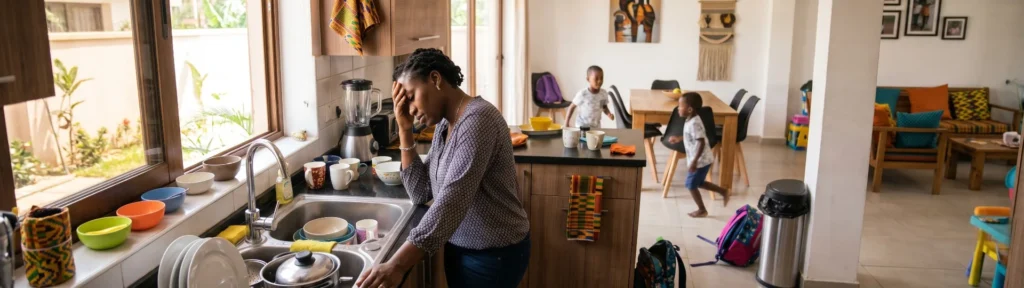
Who Is Making Dinner? The Hidden Work Behind Ghanaian Family Meals
New research on unpaid care in Ghana raises a question that starts in the kitchen but reaches into work, family health and the value of time.
By Nkwa Dua Editorial · Research-based feature · November 2026
Some days, the hardest part of making dinner begins long before anyone enters the kitchen. It starts with the question of who will decide, buy, prepare, serve, clean, and do it all again tomorrow.
The question behind the photograph
A woman pauses with one hand against her forehead beside a kitchen sink crowded with dishes. In the rooms behind her, children move about. There is a dining table and the evidence of a household in motion. The picture does not establish anything about the person’s identity, her wellbeing, or the circumstances of the family shown. Used as an editorial illustration, however, it raises a question that deserves closer attention: who is carrying the daily responsibility for keeping everyone fed?
Food work is often discussed as though it begins when a pot goes onto a stove. In practice, someone must anticipate what people will eat, understand preferences, calculate what is available, obtain ingredients, prepare dishes, supervise mealtimes, clean afterward, and repeat the process. A plate of food can disappear in minutes while the unseen work behind it stretches across an entire day. The social question is not whether families enjoy home cooking. Many do. The more important question is whether the work is fairly shared, realistically supported, and sustainable for the people doing it.
What Ghana’s care-work numbers reveal
A June 2026 Ghana News Agency report on research presented through the UCARE initiative described a striking national difference: women spent an average of 147 minutes a day on unpaid care work, compared with 49 minutes for men. The researchers drew on the Ghana Living Standards Survey and Ghana Time Use Survey. These are averages, not descriptions of every home; a family with shared caregiving duties might look very different. But the national disparity gives the issue a measurable foundation.
Unpaid care includes far more than cooking. It can involve childcare, care of older or ill relatives, washing, cleaning, water collection, and the logistics of maintaining a household. The same report found still larger gaps in parts of northern Ghana. If an essential activity is not reflected in a payslip, it can be easy for families and institutions to undervalue it. Yet the hours remain real. Each hour spent on domestic work is an hour that cannot simultaneously be spent on paid work, study, leisure, community service, or rest. That is why the debate about dinner belongs in a wider conversation about time, dignity, and opportunity.
A working day does not end when paid work ends
Research on work and commuting in the Greater Accra Region offers another perspective. A study of long work hours and time poverty found that working days were already long and commuting added substantially to the daily burden. In the research, women’s combined working days were about 0.8 hours longer than men’s on average, with unpaid household work playing an important role. The researchers also highlighted the impact of transport and the demands faced by self-employed people.
Imagine how that schedule interacts with meals. A person may complete professional assignments and travel across the city only to begin ingredient preparation, cooking, clearing the table, packing leftovers, and arranging food for the next morning. This is not evidence that every woman in Accra experiences the same pressure, nor that men do no household work. It shows why a household routine cannot be evaluated simply by asking whether someone is employed. Paid work and family work may form one continuous shift. For households seeking better balance, the starting point should be to make all of that labor visible instead of treating dinner as an isolated hour on the calendar.
The mental work before the chopping begins
Some of the burden is physical and obvious: washing vegetables, tending a pot, cleaning counters, and carrying shopping bags. Some of it is mental. A caregiver may notice that rice is almost finished, remember a child’s food preference, anticipate a late meeting, estimate how much of a dish will be left for lunch, and decide whether the household can afford a particular ingredient this week. These decisions may happen while doing unrelated work. They are difficult to count, but easy to recognize once someone asks who makes them.
Calling this process “meal planning” can make it sound like an occasional task, neatly completed on Sunday evening. In reality, decisions continue as school schedules change, visitors arrive, grocery prices fluctuate, and individuals develop new needs. A family may reasonably prefer home-cooked food and still need a different division of responsibility. Partners, older children, extended relatives, community services, and professional food providers can all contribute in appropriate ways. The goal is not to eliminate care or replace cultural traditions with an outsourced system. It is to ensure care does not quietly become an unlimited obligation for one person merely because that is what everyone has grown accustomed to.
Why food expectations can be emotionally complicated
Food is not only fuel. Across Ghanaian households, familiar meals can signal comfort, celebration, heritage, generosity, and belonging. A parent may take particular satisfaction in preparing a child’s favorite dish or teaching the next generation how to cook. A grandparent may insist that a family gathering would not be complete without a particular recipe. These expectations can be meaningful and worthy of preservation. They can also become heavy when the responsibility for meeting them falls on too few shoulders.
That tension deserves a more thoughtful response than telling families to stop caring about what they eat. The issue is how to preserve what matters while changing the distribution of work. A homemade Sunday meal can remain a shared ritual without requiring one parent to plan every breakfast, lunch, and dinner in the week. An elder can pass on recipes while inviting younger family members to participate in preparation and cleaning. A couple can agree that one person cooks while the other manages shopping, packing, and dishes. The tradition of hospitality is strengthened when those offering it can also experience its generosity.
CHEFSELECT | More time around the table
Chef-prepared meals curated around your household’s tastes and schedule.
Nutrition introduces another layer of responsibility
The person deciding what to serve often faces pressure to make meals nourishing as well as enjoyable. Ghana’s Food-Based Dietary Guidelines emphasize variety, food safety, and diversity across food groups. That is a sound public-health direction, but translating dietary guidance into everyday family meals is not automatic. A household needs affordable ingredients, sufficient time, preparation facilities, appropriate storage, and practical ways to accommodate children and adults with different needs.
It is especially important not to interpret every nutrition finding as a judgment of mothers. The 2022 Ghana Demographic and Health Survey reported that about 17% of children under five were stunted, while 50% of women surveyed achieved the study’s minimum dietary-diversity measure. These indicators reflect complex conditions, including access to food, health services, sanitation, income, and other factors. They cannot be explained by how hard one individual cooks. A responsible discussion of family nutrition therefore looks beyond the kitchen counter. It asks whether households have the resources and shared support necessary to put good intentions into practice consistently.
Why a well-fed family is not a one-person project
Sometimes conversations about food imply that a capable mother should manage everything: good nutrition, cultural expectations, children’s preferences, household costs, and a cheerful dinner atmosphere. That standard is neither realistic nor fair. Family health depends on more than the diligence of the person preparing meals. It also depends on how resources and labor are distributed, whether people can access appropriate information, and whether the household has the ability to adapt when circumstances change.
A better framework assigns responsibility across the family. One person may coordinate the budget, another may do grocery purchasing, and another may prepare food or clean up. Children can participate in age-appropriate ways without being assigned adult responsibilities. Partners can learn the household’s recipes rather than treating them as the private knowledge of one person. Families with sufficient resources may also buy prepared meals, arrange deliveries, or ask for help during demanding periods. Those choices are not admissions of failure. They are different ways of organizing work. The relevant standard is whether everyone who depends on the household also recognizes the effort required to sustain it.
When time poverty becomes the real ingredient
The phrase “time poverty” describes a situation in which paid work, necessary household tasks, and other obligations leave too little discretionary time for rest or personal life. It helps explain why a family may value fresh food and still find regular cooking difficult. Time cannot be placed in a shopping basket, but its scarcity affects every decision. A person who spends an extra hour preparing a meal may not have that hour for exercise, sleep, family conversation, or professional development.
The research on Greater Accra’s workdays and commutes demonstrates why this matters locally. When travel and unpaid work are counted together, the picture of a household’s daily schedule changes. Time-saving practices should therefore be judged by the whole routine, not just the cooking method. Washing and chopping ingredients in advance may save time; so might sharing shopping duties, freezing suitable portions, selecting simple meals, or arranging professionally prepared food on difficult days. There is no single correct solution. The central point is that the person with the heaviest workload should not also be expected to solve the time problem alone.
The hidden economics of dinner
Household food spending is usually discussed in terms of ingredients and the final bill. Yet the true cost of a home meal includes the time spent planning, buying, cooking, and cleaning, along with energy, transport, storage, and food that goes unused. These costs do not necessarily make home cooking uneconomical. Cooking at home can be deeply rewarding and may be less expensive than purchased meals, particularly for households managing tight budgets. But a comparison that ignores time and effort is incomplete.
Consider two households preparing the same dish. One has easy access to ingredients, reliable refrigeration, a flexible work schedule, and several people sharing preparation. Another faces a demanding commute, limited storage, unpredictable availability, and one adult doing nearly everything. The ingredient receipt may look similar, while the practical burden is very different. A useful household budget therefore includes both money and time. It asks which meals are worth cooking from scratch, which can be prepared in batches, which require special occasions, and where purchasing a prepared dish might genuinely make life easier. The objective is better use of available resources, not a universal rule that cooking or ordering is always superior.
A more useful question than “What’s for dinner?”
Families can begin with a small but revealing change in language. Instead of asking one person what has been planned, ask what everyone can contribute. Instead of assuming food appears at a certain hour, discuss the tasks and timing required. Instead of measuring care solely by whether a meal was cooked at home, consider the thought and coordination that went into the family’s wellbeing throughout the day. Those changes sound modest, but they can reveal patterns that have become invisible through repetition.
A weekly conversation might identify the evenings when the household genuinely wants to cook, the days when people are likely to arrive late, and the meals everyone enjoys enough to repeat. It can establish who shops, who cleans, who packs lunches, and how dietary needs will be addressed. Even a simple plan remains flexible: life rarely follows a perfect schedule. The point is not to create another administrative chore for the person already overloaded. It is to make the work visible enough that the family can negotiate responsibility openly. Better dinner routines begin before anyone reaches for the first ingredient.
Planning a week without turning life into a spreadsheet
A practical food routine does not have to involve meticulous charts, rigid meal schedules, or an elaborate set of rules. Families can begin by identifying three different kinds of meals: those worth preparing as a shared activity, those that can be made in advance, and those that are easier to arrange through other trusted sources. The categories may overlap. A family might enjoy preparing waakye on a weekend, cook a simple vegetable dish during the week, and buy a professionally prepared meal on a particularly busy evening.
The framework works best when it reflects the household’s real week rather than an idealized one. Consider school activities, paid work, religious or community commitments, access to ingredients, refrigeration, and the actual appetite of different family members. Plan some variety, but leave room to change course. An inflexible plan can create more stress than it removes. The purpose of anticipating meals is not to control every outcome; it is to avoid beginning every day with the same unsolved problem. A thoughtful routine should simplify decisions without making eating feel like an administrative project.
Children can learn about food without inheriting an unfair burden
When children understand what goes into meals, they can develop valuable practical skills and a deeper appreciation for those who care for them. Washing produce under supervision, helping lay the table, assisting with age-appropriate preparation, and clearing up after eating can turn some household work into shared learning. Older children may learn to plan simple meals or prepare snacks safely. These experiences can strengthen independence while respecting the family’s culture and recipes.
The distinction is between participation and replacement. Children should not be expected to carry adult caregiving responsibilities because adults lack sufficient support. Tasks must suit their age and abilities, and safety around heat, knives, allergens, and food storage matters. The same principle applies to gender: cooking and cleaning are life skills, not duties assigned by whether a child is a boy or a girl. Teaching all children to respect food work can influence the expectations they take into adulthood. A future in which more people share responsibility begins with the everyday example children observe: who is allowed to rest, who prepares food, and who is expected to notice that the dishes still need washing.
Why fathers and partners belong in the conversation
It is tempting to frame the solution to women’s time pressure as advice for women to become more organized. That misses the fundamental issue identified in care-work research: the division of responsibility itself. A household cannot meaningfully rebalance the work if one person must still instruct, remind, supervise, and correct everyone else’s contribution. True sharing involves ownership of tasks, including noticing when they need doing.
A partner who takes responsibility for two weekly dinners, grocery restocking, or children’s lunches should be able to manage those responsibilities without constant oversight. The work may be shared in many ways depending on employment schedules, physical capacity, family structure, and preference. Equality does not require that every task be split identically every day. It does require that every adult’s time be treated as valuable. Men who already shoulder substantial caregiving responsibilities deserve recognition, too. The point is not to turn dinner into a competition or a scorecard. It is to make household arrangements explicit enough that no one is indefinitely overburdened by assumptions. A more sustainable family food system is one in which care is practiced by everyone who can contribute.
What happens when a household depends on one cook
A household organized around one person’s constant availability can function smoothly until that person becomes ill, travels, works longer hours, or simply needs rest. Then even routine decisions may become unexpectedly difficult: which ingredients are in the cupboard, what can be reheated, what a child will eat, or where to obtain a dependable meal. This is a practical vulnerability as well as a fairness issue.
Sharing knowledge is therefore part of household resilience. More than one adult can know the family’s common recipes, dietary restrictions, preferred suppliers, and food-safety routines. A clearly organized kitchen and a small list of reliable meals can help. Families may also maintain a few backup options for busy periods, whether that means frozen portions, prepared staples, a trusted nearby provider, or help from relatives when appropriate. These precautions are not evidence that someone is less committed to family life. They make care less fragile. A resilient household should not come to a standstill because its most relied-upon cook has a demanding week. The ability to distribute food work may be as valuable as any individual recipe.
Eating well is different from eating perfectly
Food advice can become overwhelming when it presents a single ideal plate or a rigid rule about what every family must eat. Ghana’s national food-based dietary guidance emphasizes a varied diet, moderation, and safe handling, but households still need flexibility for individual circumstances. Different ages, activity levels, health conditions, cultural practices, and food preferences require different approaches. No one meal can carry every nutritional expectation, and a family does not need to make every dinner look like a textbook illustration to benefit from gradual improvements.
A realistic conversation begins with what is already accessible. Where could vegetables or fruit be included more often? Can a range of legumes, grains, and other foods be rotated? Are meals stored safely? Can people drink water regularly and vary high-sugar or high-salt options when practical? For people with medical nutrition needs, professional guidance may be essential; a general article or a food service cannot substitute for individualized medical care. Most importantly, nutritional responsibility should be shared and supported. Telling a tired caregiver to become more disciplined does little to help when income, availability, time, or household cooperation are the real constraints. Better food decisions become possible when the surrounding conditions improve.
What Ghanaian food traditions can contribute
The conversation about time pressure should not erase the creativity already present in Ghanaian cooking. Across regions and households, a rich range of grains, tubers, legumes, vegetables, herbs, fruits, and preparations provides opportunities to develop meals that are satisfying and varied. The details differ from home to home, and no single menu represents the full culinary landscape. What many dishes share is a capacity for adaptation: flavors and techniques travel between generations while cooks respond to available ingredients.
A family may build a week around dishes they already enjoy, varying the sides, vegetables, and accompaniments rather than treating variety as a demand for entirely new recipes each day. Beans, rice, leafy vegetables, plantains, and other familiar ingredients can participate in different culinary combinations. For households interested in plant-based options, Ghanaian food traditions offer a meaningful starting point rather than something to be abandoned. Nkwa Dua approaches this field through contemporary Pan-African cuisine, not by arguing that one way of eating makes a family morally superior. Good food should create curiosity and pleasure. When a meal routine preserves those experiences while reducing unnecessary labor, culinary heritage and practical household wellbeing can support one another.
Food safety does not disappear when someone else cooks
Prepared meals can save time, but convenience never removes the need for responsible food handling. Whether food is cooked at home, prepared by a relative, or purchased from a restaurant, the same basic questions matter: how long has it been stored, how was it transported, and can it be kept at a safe temperature until it is eaten? A beautiful photograph cannot answer those questions. Providers and households should communicate clearly about storage and reheating guidance appropriate to the particular dish.
Families arranging several meals at once should assess their available refrigerator or freezer capacity before ordering. Containers need to be suitable for the food and accurately labelled when different meals or dietary requirements are involved. People should follow applicable food-safety advice rather than rely on a universal claim that every cooked dish remains safe for the same number of days. Those with allergies require special attention to ingredients and possible cross-contact. A professional supplier should be candid about what can and cannot be accommodated safely. The objective is not simply to reduce kitchen work; it is to do so without creating uncertainty about food quality or safety. Clear instructions and realistic expectations are part of good hospitality.

FROM THE NKWA DUA KITCHEN
Food support that starts with listening
Chef Ama develops personalized meal selections around household preferences and practical needs. An example of how one culinary service approaches the pressures explored in this article.
The outsourcing question, without the stigma
Some households have always relied on shared cooking arrangements, family members, market sellers, food vendors, or outside help. The idea that a respectable family must prepare every dish entirely within its own kitchen is therefore a narrow way to judge care. Purchased food can be part of a sensible routine, just as cooking at home can be an expression of pleasure and identity. The right balance depends on cost, access, quality, taste, health needs, and the household’s values.
Outsourcing also introduces questions about the workers providing the service. Professional cooks, vendors, and delivery workers have their own workloads and deserve fair and safe conditions. A solution that saves one person time should not depend on invisible or exploitative labor elsewhere. Customers can consider transparency, reliability, clear prices, practical service policies, and the treatment of workers when choosing providers. The most thoughtful approach recognizes that every meal involves people and systems, not just ingredients. The key is to make conscious choices rather than treating either home cooking or purchased meals as a moral test. Families can preserve meaningful cooking traditions while using outside support in ways that genuinely improve daily life.
What employers and institutions can change
The balance between household work and paid work cannot be solved exclusively inside the family. Employers and public institutions influence the hours, transport patterns, and flexibility that shape people’s ability to care for relatives. Predictable schedules, reasonable working expectations, safe transport, and policies that recognize caregiving responsibilities can make a difference. These are not special concerns of mothers alone. Workers of every gender may have children, older relatives, or other dependents.
The Greater Accra time-poverty research helps explain why these decisions matter. Long combined days leave people with fewer opportunities to recover, develop skills, or participate in community life. A workplace that expects unlimited availability may be shifting costs onto families in ways that remain outside its accounting. Educational institutions can also help by recognizing that household support affects students and caregivers. The broader policy discussion includes access to childcare, basic services, transport, and protection for workers involved in care. None of these measures replaces personal responsibility within a household. Rather, they can make equitable family arrangements more achievable. A conversation that begins with dinner eventually reaches the design of work and public life.
Why the value of domestic care is so easy to miss
If a household hires someone to cook, clean, or supervise children, the work becomes a visible expense. When a family member performs the same activities without a wage, that contribution can disappear from conventional calculations of income. This does not mean unpaid care has no value; it means its value is often measured differently from paid employment. National time-use research tries to make that work more visible by identifying how people actually spend their days.
The UNICEF Ghana social-protection roadmap describes the unequal distribution of unpaid household responsibilities and identifies cooking and childcare as important components. Such findings should prompt questions about what households and institutions take for granted. Counting hours alone cannot capture the emotional significance of care, and not every family wants to monetize intimate relationships. But failing to count labor at all can justify unrealistic expectations. Respecting care means recognizing its time, energy, knowledge, and opportunity costs, while making sure the people who offer it are also supported and able to pursue their own goals.
The financial choices families actually face
No responsible discussion of meal support can assume that every family can pay for a personal chef or a delivery service. For many households, the pressing question is how to meet basic food needs amid competing expenses. Others may have sufficient spending flexibility but limited available time. These are different problems, and solutions must respect the difference. A useful assessment begins with what the household already spends on food, transport, utilities, and occasional purchased meals, not with a provider’s promotional promise.
Families may discover that buying some prepared items is workable while arranging an entire week of meals is not. They may choose simpler dishes, batch preparation, cooperative shopping, or a shared cooking schedule. Others may find that professional preparation fits their current resources and improves their routine. Neither choice is inherently superior. The practical test is whether it improves food reliability, preserves enjoyment, respects the family’s needs, and remains financially sustainable. An attractive advert can start a conversation; it should never conceal the real costs or imply that an expensive solution is the only route to relief.
The questions worth asking a meal provider
Before arranging chef-prepared weekly meals in Accra, it is worth asking how the service learns what the household actually enjoys. Is the menu fixed, or can dishes be curated? What is the minimum quantity? How are dietary restrictions handled? What happens when a preferred ingredient is unavailable? Are portions clearly defined? Can the household review and approve its selections before preparation? These questions distinguish a personal service from a standard bulk-food package without suggesting one model is always better.
Practical details also matter. Confirm whether the provider serves the exact delivery address, the order deadline, how meals are packaged, when payment is required, and what storage and reheating information accompanies each dish. Some people want daily delivery; others value one thoughtfully arranged batch. Some households need food for two people, while others are managing varied needs across a much larger family. Careful planning is not an excuse to ask one parent to do all the coordination. Wherever possible, the people who will eat the meals should contribute to identifying preferences and managing logistics. Convenience becomes meaningful when the entire process, not only the cooking, is easier.
What plant-based options can contribute
A family does not need to identify as vegan to enjoy thoughtfully prepared plant-based food. Ghanaian culinary ingredients already offer room for dishes built around grains, legumes, vegetables, roots, tubers, spices, and fruit. For some families, these options can introduce variety or accommodate personal food preferences. For others, they can be part of a broader eating pattern that includes different kinds of meals. The point is culinary possibility rather than dietary judgment.
Plant-based cooking still needs the same attention to dietary adequacy, ingredient safety, and personal requirements as any other approach. A dish cannot be assumed to meet every nutritional need because it contains vegetables, nor should a food provider make medical promises based on menu labels. Nkwa Dua’s approach is to explore contemporary Pan-African flavors and ingredient creativity while communicating clearly that its offerings are plant-based. Families can assess the menu according to what they genuinely enjoy and what suits their routine. A good food experience can be satisfying without turning a meal into a debate about identity. Hospitality begins with understanding who is coming to the table.
The difference between help and another assignment
When a service promises convenience, the household should be able to evaluate whether it really reduces work. A system that demands lengthy daily messaging, constant corrections, confusing choices, and repeated follow-up may simply move the burden from the kitchen to the phone. The same applies within families: telling one person to delegate tasks is not helpful if that person must spend the evening supervising every detail. Real relief should simplify decisions, clarify ownership, and reduce the number of things that require attention.
One way to assess this is to follow the entire sequence from idea to meal. Who chooses the food? Who checks ingredients? Who confirms dietary needs? Who makes payment? Who receives delivery? Who labels and stores the dishes? Who cleans afterward? A thoughtful household process distributes those activities, while a responsible provider explains its own part without ambiguity. Sometimes an individual restaurant order is enough. Sometimes a recurring arrangement creates more value. The answer depends on the life around the meal. The standard should be practical ease, not a slogan about saving time. More than anything, people deserve a system they can rely on when the day has not gone according to plan.
A different understanding of family hospitality
African hospitality is often celebrated through the generosity of the table. Preparing food for others can express affection, solidarity, respect, and pride in culinary heritage. That deserves recognition. Yet hospitality should not be measured only by how much one person sacrifices to deliver it. A household can be warm and generous while also protecting the time, health, and autonomy of those who prepare its meals. The ability to host with care should not depend on exhaustion.
This is where a conversation about Ghanaian mothers and family meals becomes more than a discussion of kitchen efficiency. It raises questions about who receives care, who offers it, and whether the roles can change when circumstances demand it. Shared planning, fair participation, and thoughtful external support can preserve a culture of welcome while making it more sustainable. A meal is most meaningful when everyone involved has room to enjoy it. The person who prepared dinner should not always be the last one to sit down or the first one to begin cleaning. A better model of hospitality makes a place at the table for the caregivers themselves.
What this means for Ghanaian households now
The evidence does not suggest that there is one solution for every family. Some households face challenges rooted in income or access to essential services. Others face long commuting times or uneven divisions of household labor. Many experience several of these pressures simultaneously. The 2026 Ghana care-work findings make the unequal distribution of responsibility difficult to ignore, while research on Greater Accra shows how that burden interacts with paid work and travel. Nutrition guidance adds another dimension, emphasizing the importance of safe and varied food without explaining away structural barriers.
For a family wondering where to begin, the practical questions are straightforward: What food work needs to happen this week? Who currently performs it? Which tasks can be shared, simplified, prepared ahead, or supported in other ways? What genuinely matters about the meals the family loves? And what changes would give the busiest caregiver more breathing room without compromising everyone’s wellbeing? None of these questions requires abandoning Ghanaian food traditions. They invite families to protect those traditions by ensuring the labor behind them is understood and respected.
The real question is who gets to rest
The picture of a crowded kitchen captures attention because many viewers can recognize the feeling of a day that has not stopped demanding something. But the important story is not the imagined biography of the woman in the image. It is the work that too often remains unnoticed in households and economic conversations. Behind dinner are decisions, time, planning, affection, money, skill, and responsibility. The figures from Ghana’s care-work research show why it is worth treating that work as a public issue rather than a private inconvenience.
A good family food system should offer more than a reliable meal. It should distribute responsibility fairly, encourage a varied and enjoyable diet, leave room for meaningful rituals, and make rest possible for the people who provide care. Cooking can remain a source of pride. Shared meals can remain central to family life. What deserves reconsideration is the assumption that those benefits must depend on one person’s endless availability. The most revealing question at the end of the evening may not be what the family ate, but whether everyone, including the person who made it possible, finally had a chance to sit down.
Sources and reporting notes
This Nkwa Dua editorial feature draws on published research, not interviews with the people depicted in the illustrative photograph. National and regional research findings are differentiated; no individual household is presented as representative.